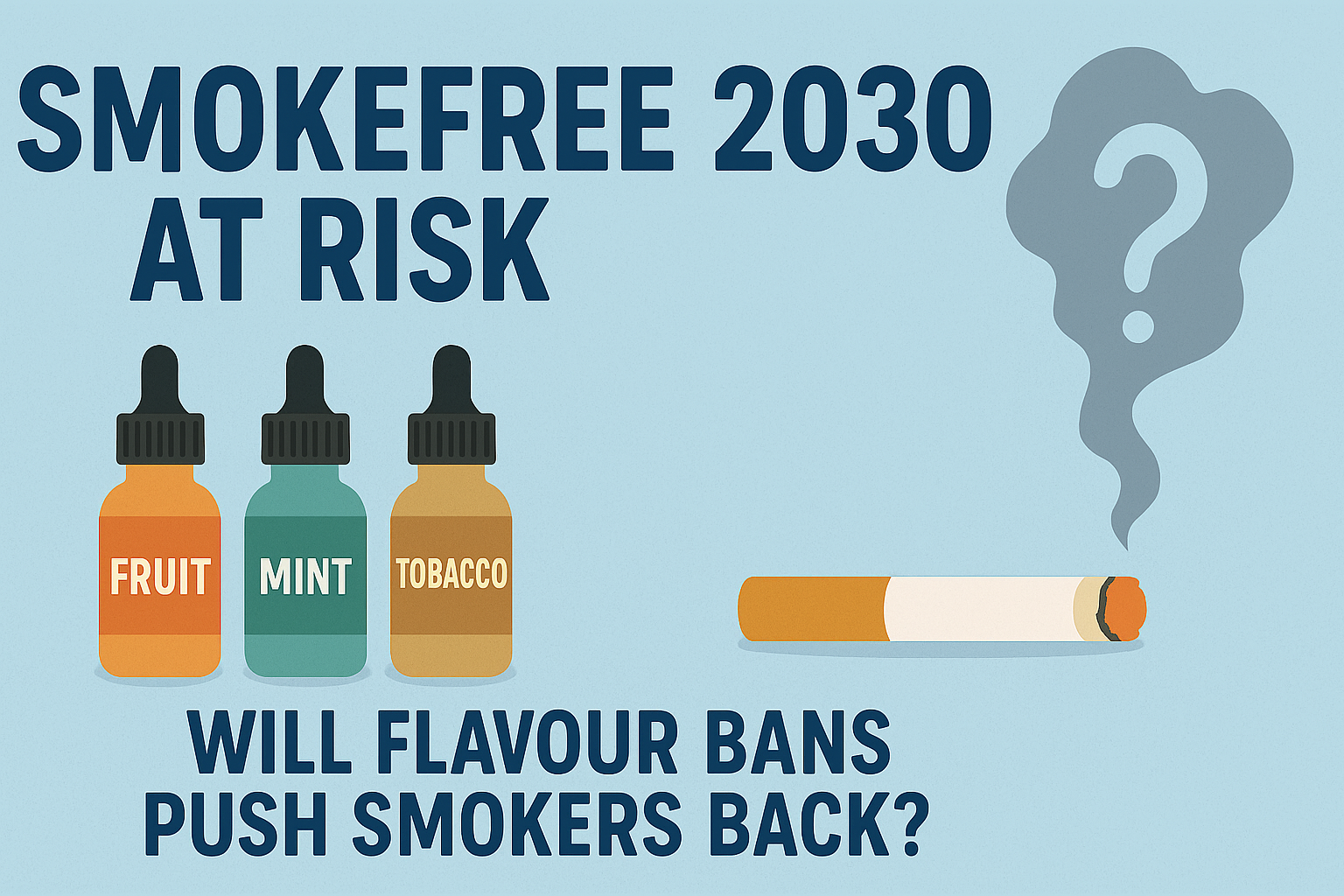
Few topics in the vaping world stir as much debate as flavour bans. Lawmakers argue that sweet and fruity E-liquids attract younger users, while many adult vapers insist those very flavours helped them move away from cigarettes for good. Now, a growing body of research is shining a light on what actually happens when flavours are taken off the shelves – and the picture is far more complicated than expected.
U.S. Findings: Less Vaping, More Smoking

Researchers at Mass General Brigham, published in JAMA Network Open, looked at six U.S. states (Maryland, Massachusetts, New Jersey, New York, Rhode Island, and Utah) that enacted vape flavour bans in 2020.
- Vaping among young people and adults declined significantly.
- Vaping dropped by nearly 7 percentage points in 2022 among 18-24 years-olds.
- Adults use dropped by about 1 percentage point by 2023.
- Teen vaping dropped by 24.1% (2019) to 14% (2023) compared to a decline from 24.6% to 17.2% in other states.
Not only did smoking not fall as much in the ban states, in some groups, it went upwards. These patterns confirm what the experts have been warning: flavour bans, while curbing youth vaping, are inadvertently slowing progress on reducing smoking.
Douglas Levy, PhD. Director of Policy Research at the Tobacco Research & Treatment Center of Massachusetts General Hospital, said:
“Both e-cigarettes and combustible cigarettes are essentially a source of nicotine for people who may have nicotine dependencies. We’re trying to solve the problem of youth vaping, but we need to carefully consider impacts on more harmful combustible cigarette use.”
Massachusetts saw consistent decreases in vaping associated with the bans across age groups, which could be due to the presence of earlier local bans and stronger enforcement. Other states, such as Utah and Maryland, allowed certain exemptions (e.g. menthol flavours or specialty shops), which may have modified the impact of their bans. Even so, none of the states showed robust declines in cigarette use after the bans.
ASH Warn of Public Health Disconnect
Action on Smoking and Health (ASH) has warned that current vaping regulations are failing on two fronts – allowing youth vaping to rise while not doing enough to help adults quit smoking. The organisation argues that vaping remains underused as a quit tool but overused by teenagers, calling for urgent government actions to restore balance.
ASH is urging:
- Immediate scheduling of the Committee Stage to unlock new regulatory powers aimed at curbing youth vaping.
- Swift implementation of measures following Royal Ascot, including:
– Banning brightly coloured vape packaging and flavour names.
– Tightening rules on advertising, point-of-sale displays, and marketing practices that appeal to under-18s. - A stronger national communications campaign to:
– Reiterate that smoking remains far more harmful than vaping.
– Encourage smokers to make the switch.
– Support quit-focused initiatives such as the Swap to Stop programme.

Hazel Cheeseman, Chief Executive of ASH, warned that the UK is “stuck in a dangerous limbo,” where misinformation about vaping is deterring smokers from switching, while young people continue to be exposed to products designed to appeal to them.
“Inaction by the last government, and now delays by this one, mean we’ve waited too long to act,” Cheeseman said. “We must urgently pass regulations to reclaim vaping as a quit aid, reduce youth vaping, and get the UK back on track to end smoking.”
Labour Peer Lord Faulkner of Worcester, a long-standing member of the All-Party Parliamentary Group (APPG) on Smoking and Health, echoed this call:
“I strongly support all efforts to reduce the public’s dependence on nicotine. The appeal of vaping to children is a particular concern. The Tobacco and Vapes Bill is a real opportunity to make a lasting change for the better and must be a top priority for Parliament”

Professor Ann McNeill, an expert in Tobacco Addiction at King’s College London, also stressed the need for balanced regulation:
“The persistently high levels of youth vaping we’re seeing it concerning – not just for young people themselves, but also because they’re driving wider public fears about vaping which risk overshadowing the vital role vaping plays in helping adults quit smoking.
“Additionally, there are deeply troubling signs that falls in youth smoking may have stalled. There are a few things more likely to curb a child’s future life expectancy than taking up smoking and stalling progress should be a cause for serious alarm.” McNeill added that the Tobacco and Vapes Bill offers a “critical opportunity” to protect both adults and young people: “Strong legislation can make smoking obsolete while curbing youth vaping. The goal must be to preserve vaping as a harm-reduction tool for smokers, without allowing it to appeal to children.”
Flavours Play a Key Role in Quitting

In another study – “E-liquid flavours and nicotine concentration choices over 6 months after a smoking cessation attempt with ENDS” – published in the Tobacco Prevention and Cessation journal, a team of researchers explored how flavour and nicotine preferences evolve as people transition from smoking to vaping.
The Swiss-based study followed 622 adult smokers who smoked at least five cigarettes per day and were willing to quit. Participants were given free e-cigarette kits, six flavour options (tobacco, menthol, and a range of fruit flavours), and four nicotine strengths (0, 6, 11, and 19.6mg). Over six months, researchers tracked changes at weeks 1, 2, 4, 8, and again at the six-month mark.
At the start, flavour choices were similar between exclusive e-cigarette users and dual users (those who vaped and smoked). However, by the end of the study, a clear pattern emerged: those who had successfully switched to vaping exclusively were more likely to be using fruity flavours (31%) compared to dual users (22%), and less likely to be using tobacco flavours.
This shift suggests that non-tobacco flavours play a role in helping people stay off cigarettes. Over time, successful quitters appeared to move away from tobacco-like tastes toward more appealing flavours – an evolution that may help them maintain their smoke-free status.
The researchers concluded that having a variety of flavours available likely supports quitting by making vaping more enjoyable and sustainable. They noted that exclusive e-cigarette users tended to prefer fruitier flavours and lower nicotine concentrations, suggesting that both flavour and nicotine strength contribute to successful switching.
Importantly, the authors did not claim that fruity flavours cause people to quit – but they emphasised that the association was strong enough to deserve attention in policy discussions. Limiting flavour options, they warned, could disrupt this natural adaptation process, potentially leading to lower quit success rates.
In other words, flavour choice isn’t just about initial appeal – it’s about long-term satisfaction and helping people stick with vaping instead of relapsing to cigarettes. Removing those options could take away one of the key factors that helps smokers stay smoke-free.
What Are WHO Doing

The World Health Organisation (WHO) has recently renewed its call for a global ban on flavoured vaping products, nicotine pouches, and other reduced-risk nicotine alternatives – a move critics say could undermine harm reduction efforts and limit adult smokers’ access to effective quit tools.
The WHO argues that flavours primarily attract young people and make quitting more difficult. However, many public health advocates and harm reduction experts strongly disagree, pointing out that these claims are not supported by real-world evidence. In fact, multiple studies show that flavoured E-liquids play a crucial role in helping adult smokers quit and remain smoke-free.
Research has consistently found that most adult vapers prefer flavoured products, and that those who use them are significantly more likely to quit smoking compared to those restricted to tobacco flavours. Removing these options, critics warn, would not protect youth but instead risk driving adult vapers back to cigarettes or into unregulated black-market products, which pose far greater health risks.
Experience from regions that have implemented flavour bans – including San Francisco and Estonia – supports these concerns, with evidence showing rises in cigarette smoking and illicit trade following prohibition.

Michael Landl, Director of the World Vapers’ Alliance (WVA), has been one of the most vocal opponents of the WHO’s proposal.
“The WHO’s flavour ban proposal is a gift to black market criminals,” Landl said. “Flavours are not designed to attract kids – they are a lifeline for adults trying to quit smoking. Policymakers must reject this unscientific approach and focus on real solutions: targeted youth protection, access to safer alternatives, and honest information.”
Landl added that flavour bans are a simplistic, headline-driven response that ignore the realities of smoking cessation: “Governments must stand up for science and smokers’ rights – not repeat the mistakes of prohibition. If flavours are banned, lives will be lost.”
What this means for the UK:
While the UK has long been recognised as a global leader in tobacco harm reduction, the WHO’s push for a flavour ban could place increasing pressure on policymakers to follow suit. If such restrictions were introduced here, it could undermine the government’s smokefree 2030 goal by removing one of the key tools helping adult smokers quit. Public Health England and numerous UK health experts have repeatedly acknowledged that vaping is far less harmful than smoking, and that flavours play a major role in helping smokers make the switch. Aligning with the WHO’s prohibition-style approach could not only reverse progress but also drive more people back to cigarettes or into unregulated, illicit vape markets, ultimately harming rather than protecting public health.
Prohibition Does Not Work

Prohibition Does Not Work (PDNW) is an organisation dedicated to promoting evidence-based, progressive policies that help adult smokers move toward safer, smoke-free alternatives. Their mission is to challenge prohibitionist approaches that often do more harm than good by pushing consumers toward unregulated markets.
According to PDNW, smoke-free products such as vapes and nicotine pouches have played a key role in accelerating declines in global smoking rates. Attempts to ban or severely restrict these products do not eliminate demand – instead, they drive users toward illicit markets, reversing years of public health progress. The organisation works with non-governmental, non-partisan, and non-profit partners, as well as global public health experts, to promote sensible, harm-reduction-based solutions over prohibition.

Recent research published by the Tholos Foundation in collaboration with PDNW, titled “Analysis of flavoured vaping products as a harm reduction method: Impact of flavour bans in the real world”, provides comprehensive evidence showing how flavour bans often backfire. The paper, authored by Tim Andrews, Director of Consumer Issues at Tholos, analysed international polling and academic data across multiple countries. The findings paint a clear picture: removing flavours doesn’t stop vaping – it simply pushes people back to smoking or toward unregulated sources.
Key Findings from the Tholos Foundation report:
- Across all countries surveyed, most vapers said they use flavours to quit or reduce smoking.
- Fruit and menthol flavours were most commonly linked with successful smoking cessation.
- Studies found that flavoured vapes can increase quit success by up to 44% compared to tobacco-flavoured options.
- Flavour bans result in higher cigarette use, growth of black market activity, and DIY liquid mixing.
- In Slovenia, 66% of vapers said a flavour ban would push them to smoke or source products illegally.
- In Denmark and California, over 80% of vapers continued accessing banned flavours despite legal restrictions.
- More than 90% of adult vapers support tougher enforcement to prevent underage access.
- Most vapers favour education campaigns and restricting certain flavours to adult-only retail settings as more balanced alternatives.
- Vapers overwhelmingly reject blanket bans and want to retain access to safer, regulated products.
The message from PDNW and Tholos Foundation is clear: prohibition doesn’t work. Flavour bans fail to achieve their intended goals and instead risk undoing years of progress in tobacco harm reduction. A smarter approach – combining adult access, youth protection, and accurate public health messaging – is essential to keep smoking rates falling and prevent the growth of unsafe, underground markets.
Ban Packaging, Not Flavours

A recent study from University College London and King’s College London, published in The Lancet Regional Health, has added new insight to the debate around youth vaping and regulation. The researchers examined the impact of standardised E-liquid packaging – similar to the plain packs used for cigarettes – and how it influences the appeal of vaping products.
The study concluded that plain or standardised packaging, which removes bright colours, imagery and flavour names, could make E-liquids less appealing to young people compared with today’s fulled branded designs.
The authors wrote:
“Standardised E-liquid packaging, which also limits flavour and brand descriptors, may reduce the appeal of E-liquids to youth compared to fully branded packs currently on the market. These findings highlight the significance of flavour and brand descriptions on vaping product packaging and emphasise the need for additional research to explore their impact on adult who smoke.”
Lead author Dr Eve Taylor explained that the findings align with earlier evidence showing that regulating packaging could be an effective way to reduce youth appeal without deterring adult smokers:
“Our findings show that regulating vape packaging might be helpful by reducing vaping’s appeal to adolescents but not adults. This gets us close to striking that balance.”
The researchers also noted that adult interest and perceptions of harm were largely unaffected by plain packaging – suggesting such policies could reduce youth attraction while maintaining vaping’s role as a quit aid.
Hazel Cheeseman of ASH, welcomed the study:
“This is important research which illustrates how policymakers could better regulate vapes to protect children without damaging them as a quitting aid for smokers.”

However, John Dunne, Director General of the UK Vaping Industry Association (UKVIA), offered a strong counterpoint. He warned that plain packaging could further reinforce public misconceptions that vaping is as dangerous as smoking:
“The last thing we need is to package vaping products like cigarettes. Most smokers already believe that vaping is at least as bad for them as cigarettes, if not worse – and research like this only serves to perpetuate that dangerous myth.
“Not only is vaping the most effective way to help smokers quit, it carries only a fraction of the risk. That’s the message we need to get across to the UK’s six million smokers.”
Dunne argues that packaging should be used as an educational tool, providing clear information about harm reduction rather than mirroring tobacco packaging. He also cautioned that heavy-handed regulation could repeat the mistakes of the recent single-use vape ban, which early reports suggest has already led around 14% of former smokers to return to cigarettes.
Instead of new restrictions, Dunne called for robust enforcement of existing laws, including £10,000 fines for underage sales and the introduction of a vape licensing scheme to stop inappropriate retailers from selling vaping products.
“Vapes should be sold everywhere cigarettes are sold – but not in barber shops, butcher shops, or taxi offices,” he added, “The UKVIA has been calling for these changes for years.”
Lessons From International Research
Further evidence from international studies supports the idea that blanket flavour bans can have unintended consequences for public health. A joint study by researchers from the University of Missouri and the Yale School of Public Health found that restricting vape flavour sales led to a drop in adult vaping, but also an increase in cigarette smoking – undermining overall harm reduction goals.
The researchers warned that while the intention behind such bans is often to protect youth, the real-world effects may be counterproductive, driving some adult vapers back to smoking and potentially reversing years of progress in reducing smoking-related disease.
Interestingly, the study highlighted the state of Maryland as an example of a more balanced approach. When Maryland introduced flavour restrictions but allowed menthol-flavoured vapes to remain available, both smoking and vaping rates declined, suggesting that targeted regulations – rather than outright bans – can be more effective at achieving public health goals.
A good example of how a flavour ban can have detrimental effects – not only for existing vapers and smokers trying to quit, but for national public health outcomes – is the situation unfolding in Australia. The country’s strict prescription-only vaping model and sweeping flavour restrictions have led to a thriving black market, with unregulated products becoming widespread and difficult to control. Rather that reducing harm, these policies have pushed many vapers back to smoking and made it harder for adults to access safer, regulated alternatives.
The UKVIA has echoes these findings, warning that a nationwide ban on flavoured vapes of nicotine products in the UK could have similar consequences. They argue that removing flavoured options would push many adult vapers back to traditional cigarettes, undoing the significant progress made in cutting smoking rates and promoting harm reduction.
The message from research is becoming clear: banning flavours may reduce vaping, but it doesn’t erase nicotine demand – and too often, it brings cigarettes back into the picture. For adult vapers who’ve already made the switch, this is more than just policy – it’s about keeping the tools that helped them quit smoking. And for policymakers, it’s a reminder that not all solutions are as simple as they sound.
As this debate continues, one thing is certain: the voices of adult vapers and the evidence from real-world studies need to be at the centre of the conversation.